
Alchemist
Alchemist
“The Alchemist” is an internationally acclaimed novel that has become one of the best-selling books in history, famous for its allegorical story about following one’s dreams.
Publication Date
The book was originally published in Portuguese in Brazil in 1988.
- Initial Reception: The book initially sold poorly in its original printing.
- Global Success: It was republished a few years later and gained enormous global success, being translated into dozens of languages.
The Author: Paulo Coelho
Paulo Coelho (born 1947) is a Brazilian lyricist and novelist. He is one of the most widely read authors in the world, renowned for his inspirational fiction that blends spiritual themes with adventure and philosophy.
- Early Life: Before finding success as a novelist, Coelho had a diverse and sometimes turbulent career. He worked as a songwriter (writing lyrics for famous Brazilian artists), a journalist, and traveled extensively, experiences which heavily influence his fiction.
- Literary Style: His novels are characterized by their simple, fable-like structure, and focus heavily on spirituality, destiny, following one’s personal legend, and the interconnectedness of the universe. His work often appeals directly to universal human experiences and aspirations.
- Core Philosophy: Coelho’s central theme, especially in The Alchemist, is the concept of the “Personal Legend,” which is one’s destiny or life purpose. He teaches that when you truly desire something, the entire universe conspires to help you achieve it.
- Other Notable Works: Besides The Alchemist, his other popular novels include Eleven Minutes, The Pilgrimage, and Veronika Decides to Die.
Book Overview
The Alchemist tells the story of Santiago, an Andalusian shepherd boy who dreams of finding treasure at the Egyptian Pyramids. He leaves his comfortable life in Spain and embarks on a journey across the desert, meeting various figures—a wise king, a crystal merchant, and, eventually, an alchemist—who guide him on his path.
The novel is an allegory for the journey of self-discovery and spiritual transformation that accompanies the pursuit of one’s deepest desires.
- Profession: He is a novelist, lyricist, and playwright.
- Recognition: Paulo Coelho is famous for his philosophical and spiritual novels that shed light on themes like true love, life’s purpose, and personal journeys.
- Influence: His books have been translated into over 80 languages and have influenced billions of readers. “The Alchemist” established him as a global bestseller.
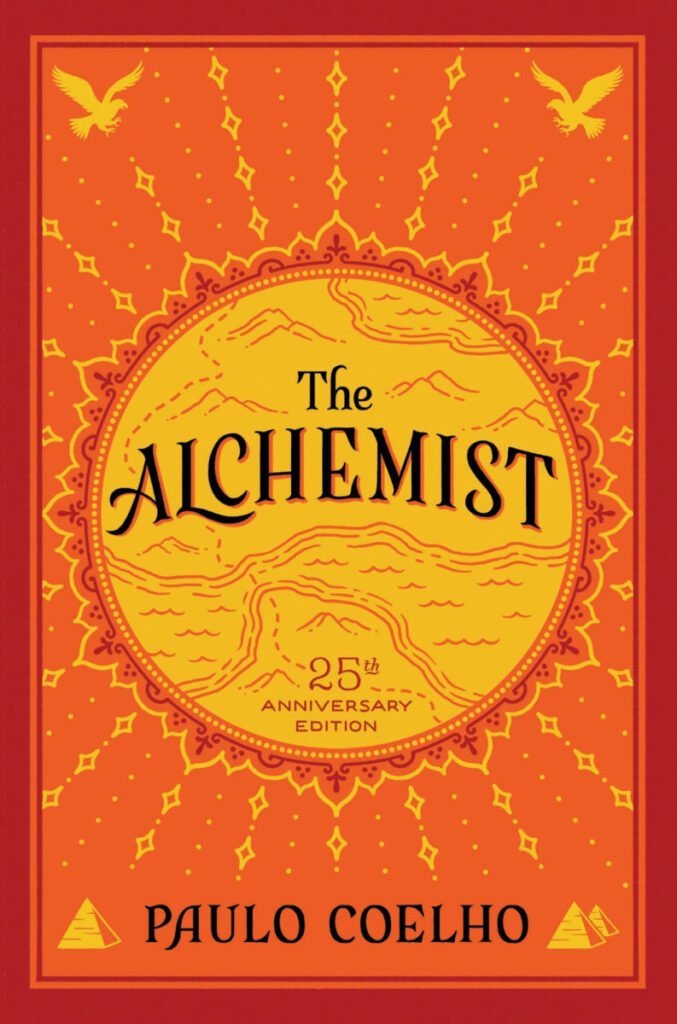
Table of Contents (Core Structure)
“The Alchemist“ is a novel, and its chapters primarily advance the plot and the hero’s journey. The book is typically divided into two major parts, representing two significant geographical phases of the story:
Part | Central Story Phase | Core Idea |
Part One | From Spain to Tangier and working with the Crystal Merchant. | The call of the Personal Legend, leaving the sheep, and understanding the omens of the world. |
Part Two | The journey through the Sahara Desert, meeting the Alchemist, and reaching the Pyramids. | The philosophy of true love, listening to the heart, and overcoming fear. |
Thematic topics within the chapters include:
- The shepherd’s life and the recurring dream
- Meeting the King of Salem and his principles
- The journey through the desert and finding love
- Meeting The Alchemist and his lessons
- Learning to listen to your heart
- The search for the treasure and its actual location
Summary
“The Alchemist“ is the tale of a shepherd boy who repeatedly dreams of a secret treasure, abandoning his comfortable life to embark on a perilous, unknown journey across the desert at the calling of his heart. This journey is not merely to the Pyramids of Egypt, but a quest into the depths of his own soul for the truth hidden within every person’s Personal Legend. The ultimate revelation is that the truth is always found where you least expected it to be.
Reasons Why People Should Read This Book
“The Alchemist” is more than a novel; it’s a modern fable that provides five powerful, universally relatable lessons about pursuing a meaningful life.
1. Inspiration to Follow Your “Personal Legend”
The core message of the book is that every single person has a unique and compelling life purpose—the “Personal Legend.” The novel acts as a profound inspiration, encouraging readers to reject complacency and take the courageous steps necessary to identify and pursue their own dreams, no matter how daunting the journey may seem. It transforms the idea of “destiny” from a passive fate into an active quest.
2. Teaches the Philosophy of Universal Alignment
The book conveys a powerful and comforting philosophical message: when you sincerely desire something from the heart, the “Soul of the World” (the entire Universe) will actively organize events, opportunities, and people to help you achieve it. This idea is a potent generator of hope, positive thinking, and faith, assuring the reader that their desires are not arbitrary but are supported by the very fabric of existence.
3. The Crucial Lesson on Overcoming Fear
The journey of the protagonist, Santiago, requires him to continuously step far outside his Comfort Zone, leaving behind a predictable life for the vast, uncertain desert. The narrative explicitly teaches that fear of failure or fear of the unknown is often more destructive than the dream itself. The book encourages readers to recognize fear as a natural hurdle—not a stop sign—that must be faced and overcome to move forward on the path of self-discovery and fulfillment.
4. The Importance of Recognizing “Omens” (Signs)
A key element of the book’s spiritual guidance is the concept of Omens (signs). The novel teaches that the Universe is constantly communicating with us through subtle hints, coincidences, and signs that guide us toward our goals. The story urges readers to develop awareness and intuition and to learn the “language of the world” so they can recognize and follow these signals, ensuring they remain aligned with the right path.
5. Profound Ideas Delivered in a Simple, Allegorical Style
Paulo Coelho’s simple, poetic language and his use of the allegorical style (a story with a hidden moral or spiritual meaning) is highly accessible. This simplicity ensures that complex philosophical concepts—like the nature of sacrifice, destiny, and alchemy—are not just understood intellectually but are felt emotionally. This makes the book’s wisdom both easy to digest for readers of all backgrounds and highly engaging, ensuring its lessons stay with the reader long after the final page.