
The 7 Habits of Highly Effective People
The 7 Habits of Highly Effective People
1. About the Author: Stephen R. Covey
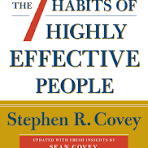
The 7 Habits of Highly Effective People was first published in 1989. The book’s original publication date is widely cited as August or September 1989, with some later editions being released in subsequent years
The author of The 7 Habits of Highly Effective People, Dr. Stephen Richards Covey (1932–2012), was a globally respected American educator, author, businessman, and keynote speaker. His work fundamentally shifted the conversation around personal and professional success from mere technique to deep-rooted character and principles.
A) The Character Ethic vs. The Personality Ethic
- Core Philosophy: Covey argued that for decades, self-help literature focused on the “Personality Ethic”—surface-level skills like positive thinking, quick tips, and public image management. Covey rejected this superficial approach, advocating instead for the “Character Ethic,“ which emphasizes foundational virtues such as integrity, humility, fidelity, temperance, courage, and justice.
- The Paradigm Shift: His main objective was to help readers achieve a “Paradigm Shift”—a fundamental change in how they view the world—by embracing timeless, universal principles that govern human effectiveness. He posits that external success cannot be sustained without internal success.
- Influence and Legacy: The book was first published in 1989 and quickly became a global phenomenon, selling over 40 million copies worldwide. It has been instrumental in training corporate leaders, educators, and government officials on principle-centered leadership.
B) The Three Stages of Growth
Covey organizes the 7 Habits into a logical progression representing three stages of human growth:
- Dependence: Where we rely on others (the starting point).
- Independence (The Private Victory): Mastering oneself.
- Interdependence (The Public Victory): Working effectively with others.
The 7 Habits are designed to move the reader sequentially through these stages.
2. Book Structure and The 7 Habits
The book is divided into four main sections: the foundation, and the three stages of the habits themselves.
Part I: The Foundation – Paradigms and Principles
- Conceptual Chapter: “Inside-Out,” “The Seven Habits—An Overview.”
Goal: To establish the importance of the Character Ethic, the concept of a Paradigm Shift, and the P/PC Balance (Production capability/Production
Part II: The Private Victory (Independence)
This section focuses on self-mastery—moving from being dependent on external factors to taking full responsibility for one’s life.
Habit | Principle | Core Concept |
Habit 1 | Be Proactive | Personal Vision: Taking responsibility for your life and choices; focusing on your Circle of Influence, not your Circle of Concern. |
Habit 2 | Begin With the End in Mind | Personal Leadership: Defining your values and mission statement; creating a mental blueprint before starting any project (first creation is mental). |
Habit 3 | Put First Things First | Personal Management: Prioritizing and executing your mission by focusing on Quadrant II activities (Important but Not Urgent). |
Part III: The Public Victory (Interdependence)
This section focuses on teamwork, communication, and collaboration—moving from independence to effective interaction with others.
Habit | Principle | Core Concept |
Habit 4 | Think Win/Win | Interpersonal Leadership: Seeking mutual benefit in all interactions, moving beyond win/lose or lose/win thinking. |
Habit 5 | Seek First to Understand, Then to Be Understood | Empathetic Communication: Listening with the intent to genuinely understand the other person’s perspective (empathic listening). |
Habit 6 | Synergize | Creative Cooperation: Valuing differences and working together to create solutions that are better than what any single person could achieve alone (1+1=3). |
Part IV: Renewal (The Habit of Continuous Improvement)
This final section focuses on sustaining effectiveness across the lifespan.
Habit | Principle | Core Concept |
Habit 7 | Sharpen the Saw | Self-Renewal: Taking time for self-care in four dimensions: Physical, Spiritual, Mental, and Social/Emotional, to increase capability. |
3. Summary
This book is an ancient philosophical cipher disguised as a modern business manual, revealing that true external power is merely the shadow cast by unshakeable internal integrity. It provides a sacred developmental sequence, teaching the seeker how to first conquer the self in Silence, then master others through Empathy, thereby unlocking the mysterious multiplicative force of synergy. The ultimate secret is that effectiveness is not an accident or a tactic, but the inevitable byproduct of immutable, ethical principles.
4. Reasons People Should Read This Book
The 7 Habits of Highly Effective People is recognized as a transformative work because it offers depth and permanence in a world of quick fixes. Here are five powerful reasons for its enduring popularity:
1. It Focuses on Fundamental Character Change (The Character Ethic)
The book’s emphasis on deep character development, rather than manipulation or quick tips, provides readers with a robust, long-term foundation for success. Covey teaches that to have more, you must be more, ensuring that success is built on a bedrock of integrity and trustworthiness.
2. Provides a Clear, Sequential Roadmap for Growth
The logical flow of the habits (Dependence , Independence , Interdependence) provides a practical and systematic path for growth. Readers know exactly which area to focus on first (the Private Victory) before attempting to influence the external world (the Public Victory), which maximizes the likelihood of success.
3. Introduces Powerful, Life-Changing Mental Tools
The book introduces several powerful, simple conceptual tools that change decision-making:
- The Circle of Influence: Where to focus your energy.
- The Quadrant II Matrix: How to manage time by prioritizing importance over urgency.
- Win/Win Thinking: A paradigm for conflict resolution and negotiation.
4. Enhances Interpersonal Effectiveness and Leadership
Habits 4, 5, and 6 are essential for anyone working in teams or leading others. Covey teaches that success in relationships requires genuine empathy (Habit 5: Seek First to Understand), which is the critical prerequisite for achieving synergistic, breakthrough results (Habit 6). This makes it invaluable for improving communication and team dynamics.
5. Promotes Sustainable Effectiveness Through Self-Renewal
Habit 7 (“Sharpen the Saw”) ensures that the effectiveness gained from the first six habits is sustainable. Covey warns that productivity (P) must be balanced with the maintenance of one’s production capability (PC). This principle mandates consistent physical, mental, spiritual, and social renewal, preventing burnout and ensuring long-term vitality.