
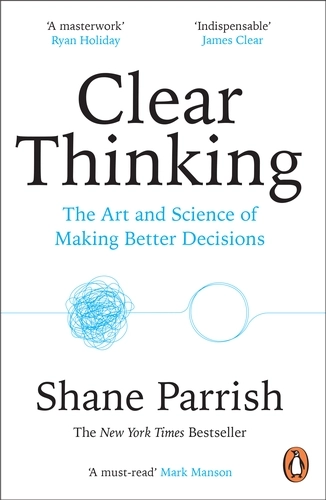
Clear Thinking by Shane Parrish
Clear Thinking
Clear Thinking Book Overview
Book Title: Clear Thinking: Turning Ordinary Moments Into Extraordinary Results
Author: The author of clear thinking is Shane Parrish
First Published: The publishing date of clear thinking is October 31, 2023
Publisher: The publisher of Clear ThinkingPortfolio / Penguin
Who is Shane Parrish?
Shane Parrish is the founder of Farnam Street, one of the most influential platforms in the world focused on decision-making, mental models, and clear thinking. Before becoming a writer and entrepreneur, Parrish worked in security and intelligence, where decisions often had serious real-world consequences. This background shaped his obsession with clarity, rationality, and avoiding costly mistakes.
Through his blog, podcast (The Knowledge Project), and newsletter (Brain Food), Parrish has helped millions of readers, investors, and leaders think better under pressure. In Clear Thinking, he brings together years of research, conversations with top performers, and practical frameworks into one powerful guide for making smarter decisions in everyday life.

Introduction to Clear Thinking
Every single day, we make thousands of decisions—most of them without realizing it. From how we react to a comment, to how we spend money, to major career or relationship choices, our decisions quietly shape the direction of our lives. Yet, despite their importance, most people are surprisingly bad at making decisions.
In Clear Thinking, Shane Parrish argues that the main problem is not a lack of intelligence. Instead, it is that we rarely pause to think clearly when it matters most. Under stress, emotion, or pressure, we default to habits, instincts, and social conditioning. We believe we are in control, but in reality, we are often running on autopilot.
The book focuses on the critical space between stimulus and response—the moment where something happens and we choose how to react. Parrish shows that learning to control this space is the key to better outcomes, better relationships, and a more intentional life.
Clear Thinking Book Chapters List
Clear Thinking is structured into three major sections, each designed to build clarity step by step:
Part I: Understanding Yourself
- Muting Internal Noise
- Self-Imposed Assumptions
- The Role of Emotions
Part II: Understanding the World
4. Information Overload
5. Noise, Pressure, and Groupthink
6. Separating Truth from Fiction
Part III: Rules for Action
7. Reverse Engineering Outcomes
8. Identifying Turning Points
9. Changing Hats: Thinking from Multiple Perspectives
10. Each section builds on the previous one, moving from self-awareness to environmental awareness and finally to action.
Core Idea of Clear Thinking
The central idea of Clear Thinking is simple but powerful:
“You don’t need to be smarter than everyone else—you need to avoid being stupid in predictable ways”.
Parrish explains that poor decisions usually come from emotional reactions, ego, fear, social pressure, and unnecessary complexity. Clear thinking is about removing these obstacles so rational thought can operate freely.
Instead of trying to think harder, the book teaches readers how to create conditions where bad decisions are less likely to happen at all. This includes designing better environments, setting rules in advance, and learning when not to act.
What Prevents Clear Thinking
One of the strongest sections of the book focuses on the enemies of clear thinking.
1. Emotions
Strong emotions—anger, fear, excitement—reduce our ability to reason. When emotions take control, we react instead of think. Parrish explains that emotions should not be ignored, but they must not be allowed to drive decisions.
2. Overconfidence
Overconfidence makes us believe we understand more than we actually do. It blinds us to risk and creates a false sense of certainty. Many failures, according to Parrish, happen not because people lacked information, but because they overestimated themselves.
3. Social Pressure
Humans are wired to seek approval. Going along with the crowd feels safe, even when the crowd is wrong. Parrish shows how social rewards often outweigh long-term benefits, causing people to make decisions they know are flawed.
4. The Zone of Comfort
When life feels “good enough,” we stop questioning our choices. This comfort zone prevents growth because clear thinking usually requires discomfort and honest self-evaluation.
Applying Clear Thinking in Real Life
Parrish emphasizes personal responsibility as the foundation of clear thinking. This means understanding your weaknesses and designing systems that protect you from yourself. For example, if you know you make impulsive decisions, you should remove temptations instead of relying on willpower.
Another key principle is learning to define the real problem before attempting to solve it. Many people rush to solutions without fully understanding what needs fixing. Clear thinkers slow down, ask better questions, and focus on root causes rather than surface symptoms.
The book also highlights that not all decisions deserve equal effort. If a decision is low-risk and reversible, overthinking it is a waste of time. Clear thinkers save their energy for decisions that truly matter.
Summary of Clear Thinking
- Clear Thinking explores the silent moments where choices are shaped before action begins.
- It reveals how unseen forces quietly control our decisions unless we intervene.
- By removing noise, emotion, and bias, clarity emerges.
- In mastering thought, we master outcomes.
Five Reasons Why People Should Read Clear Thinking
1. It Teaches You How to Think, Not What to Think
Clear Thinking does not offer opinions or motivational talk. It provides frameworks that help readers analyze situations independently and make better decisions in any area of life.
2. It Helps You Make Better Decisions Under Pressure
Drawing from intelligence and real-world examples, Parrish shows how to remain rational during high-stakes moments when emotions usually take over.
3. It Reduces Over thinking and Mental Noise
The book teaches readers how to filter information, ignore distractions, and focus only on what truly matters—saving time and mental energy.
4. It Builds Long-Term Advantage
Small, consistent improvements in decision-making compound over time. Clear thinking leads to better habits, stronger positioning, and fewer costly mistakes.
5. It Applies to Every Area of Life
Whether it’s business, relationships, finances, or personal growth, the principles in this book are universally applicable and immediately useful.