
Deep Work
Deep Work
About the Author: Cal Newport
The author of Deep Work, Cal Newport (born 1982), is a computer science professor at Georgetown University, a prominent non-fiction author, and a well-known voice in the productivity and digital minimalism spheres. His work focuses on the intersection of technology, culture, and professional output.
Publication Date: January 5, 2016
Publisher: Grand Central Publishing (US) and Piatkus Books (UK)
A) Academic and Professional Background
Computer Science and Productivity:
- Newport’s academic expertise in theoretical computer science grounds his productivity advice in rigorous efficiency and measurable results. He is a staunch advocate of building systems that maximize output and minimize cognitive friction.
The Unconventional Expert:
- Remarkably, Newport is known for achieving high professional success—publishing numerous research papers, securing tenure at an early age, and writing best-selling books—all while maintaining a disciplined balance and actively avoiding the constant distraction of social media and shallow digital engagement (he does not have social media accounts).
Core Philosophy:
- His work challenges the contemporary “busy” culture, which often mistakes constant activity (answering emails, attending meetings) for meaningful productivity. He champions the idea that true value in the modern economy comes from rare, high-skill output, which can only be achieved through periods of uninterrupted, intense concentration—Deep Work.
B) The Definition of Deep Work
Newport defines Deep Work as:
“Professional activities performed in a state of distraction-free concentration that push your cognitive capabilities to their limit. These efforts create new value, improve your skill, and are hard to replicate.”
In contrast, he defines Shallow Work as:
“Non-cognitively demanding, logistical tasks, often performed while distracted. These efforts tend not to create much new value in the world and are easy to replicate.”
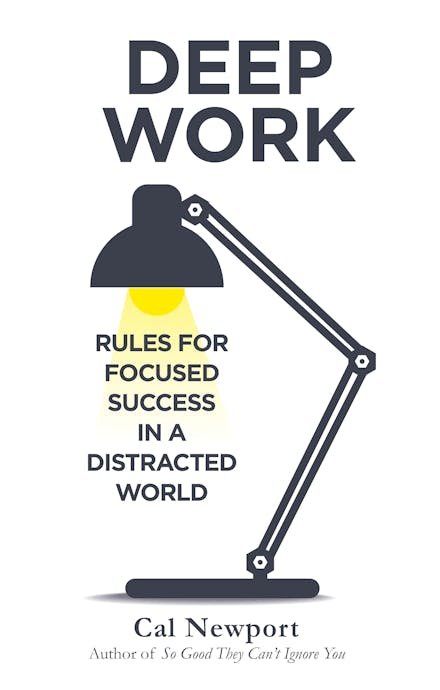
Book Structure and Conceptual Chapter List
Deep Work is divided into two major parts: The Idea (which makes the case for deep work) and The Rules (which provides the practical strategies for achieving it).
Part I: The Idea (The Case for Deep Work)
This section argues that Deep Work is becoming simultaneously Rarer (due to the rise of constant digital distraction) and More Valuable (due to the demands of the modern information economy).
Conceptual Focus | Core Themes | Key Inquiry |
Chapter 1 | Deep Work is Valuable | Why mastering difficult skills and producing high-quality output are the only paths to career success in the 21st century. |
Chapter 2 | Deep Work is Rare | How the pervasive culture of connectivity, hyper-responsiveness (email/chat), and the quantifiable nature of shallow work make deep work increasingly uncommon. |
Chapter 3 | Deep Work is Meaningful | The psychological argument: Deep work is intrinsically satisfying because the intense focus required is fulfilling, leading to flow states and professional happiness. |
Part II: The Rules (The Practical Strategies)
This is the prescriptive core of the book, detailing four rules for integrating Deep Work into one’s life.
Rule (Conceptual Chapter) | Title | Core Strategy |
Rule 1 | Work Deeply | Choosing a Deep Work Philosophy: Discusses four scheduling strategies: Monastic (isolation), Bi-modal (long concentrated retreats), Rhythmic (daily scheduled blocks), and Journalistic (opportunistic/quick switching). |
Rule 2 | Embrace Boredom | Training Focus: The anti-distraction rule. Teaches techniques to resist the impulse to switch tasks/check devices the instant boredom strikes, thereby rebuilding the brain’s concentration muscles. |
Rule 3 | Quit Social Media | Minimizing Digital Distraction: Advocates for the “Anything/Everything” approach (using a tool only if its benefit substantially outweighs its cost) over the “Any-Benefit” approach (using a tool just because it might provide some small benefit). |
Rule 4 | Drain the Shallows | Optimizing for Deep Work: Strategies for ruthlessly scheduling every minute of the day (time blocking), quantifying the value of shallow work, and adopting the “Fixed-Schedule Productivity” philosophy (start and end work at fixed times). |
Summary
This manifesto is a covert guide to cognitive mastery, arguing that the greatest source of power in the modern age is not connectivity, but willful intellectual isolation. It whispers the secret that true professional genius is forged during uninterrupted hours of extreme, distraction-free effort, which transforms effort into rare, unreproducible value. The mystery it reveals is that digital silence is the new currency, and those who master the discipline of boredom will inherit the future economy
Reasons People Should Read This Book
Deep Work has become a cornerstone of modern productivity literature because it offers both a philosophical argument and a practical methodology for maximizing professional output in the age of constant digital noise.
It Identifies the Single Most Valuable Skill of the 21st Century
The book clearly articulates that the ability to perform Deep Work is the ultimate competitive advantage in the information economy. It teaches readers that to succeed, they must move beyond low-value, easy-to-replicate tasks (Shallow Work) and dedicate significant time to tasks that demand intense focus and produce novel, high-value outcomes.
Provides Practical, Actionable, and Testable Rules
Unlike many motivational books that offer vague advice, Deep Work presents four concrete, immediately applicable rules. These rules—such as setting defined Deep Work sessions (Rhythmic), rigorously fighting distraction (Embrace Boredom), and using the “Anything/Everything” approach to technology—provide a testable system for improving focus.
Addresses the Root Cause of Modern Distraction (The Internet)
The book confronts the ubiquitous role of technology, particularly social media and hyper-responsive communication tools (email/Slack). It doesn’t merely advise “using less internet,” but gives readers a strategic philosophy for evaluating whether a tool adds substantial value, allowing them to ruthlessly prune low-value distractions that steal cognitive bandwidth.
Makes a Psychological Case for Professional Fulfillment
Newport connects Deep Work not just to financial success but to personal well-being. By citing psychological studies (like those related to flow states), he argues that intense focus is inherently more satisfying than fragmented attention. Reading the book encourages readers to structure their lives in a way that maximizes both their output and their professional happiness.
Teaches Time Management Through the Lens of Attention
The book refines traditional time management by emphasizing attention management. It introduces the Fixed-Schedule Productivity philosophy (Rule 4), which forces the user to fit work into a fixed time boundary, prioritizing Deep Work sessions and scheduling Shallow Work rather than letting it dominate the entire day. This approach ensures work-life balance while maximizing effective output.