
Good to Great
Good to Great
Publishing Date:
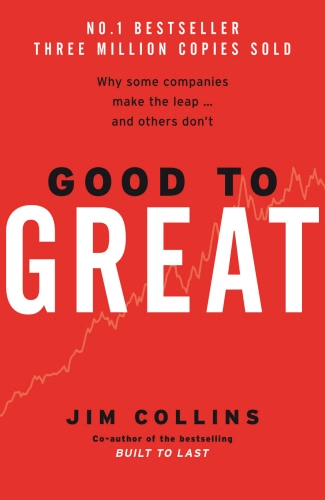
Good to Great was published on October 16, 2001.
Below is an overview of the author, Jim Collins, and his background.
About the Author Of Good To Great
Jim Collins is a researcher, author, speaker, and consultant widely considered one of the most influential management thinkers of the modern era. Unlike many business “gurus” who rely on anecdotal experience, Collins is known for a rigorous, data-driven approach to understanding what makes companies tick.
Key Biographical Details Of Good To Great
- Education: He holds a bachelor’s degree in mathematical sciences and an MBA from Stanford University.
- Career Roots: He began his research and teaching career on the faculty at the Stanford Graduate School of Business, where he received the Distinguished Teaching Award in 1992.
- The “Management Lab”: In 1995, he founded a management laboratory in Boulder, Colorado. Here, he conducts multi-year research projects to answer large-scale questions about business growth and sustainability.
His Methodology:
Collins distinguishes himself through his research method. For Good to Great, he and his team spent five years analyzing the histories of 28 companies, sifting through thousands of pages of interviews and data to identify why some companies made the leap to sustained greatness while their direct competitors did not.
Other Notable Works:
Most of his books are part of a larger body of research into what makes great companies endure:
- Built to Last (1994): Co-authored with Jerry Porras, this examines habits of visionary companies that have succeeded for decades.
- How the Mighty Fall (2009): analyzes the stages of decline in once-great companies.
- Great by Choice (2011): Co-authored with Morten T. Hansen, this looks at why some companies thrive in uncertainty and chaos.
Key Concepts Introduced by Collins
If you are reading Good to Great, you will encounter these famous concepts he coined:
- Level 5 Leadership: Leaders who blend extreme personal humility with intense professional will.
- The Hedgehog Concept: The intersection of what you are deeply passionate about, what you can be the best in the world at, and what drives your economic engine.
- The Flywheel Effect: The idea that business success is not a single push but the accumulation of effort applied in a consistent direction.

A) Research-Driven Philosophy
- The Socratic Teacher:
Collins began his career teaching at the Stanford Graduate School of Business. He has dedicated his professional life not to consulting on how to make decisions, but to researching which decisions lead to enduring success. His work is characterized by its rigorous, data-intensive approach, contrasting sharply with anecdotal or opinion-based business books.
- The “Good to Great” Research Project:
This book is the result of a massive, five-year study conducted by Collins and his team. They meticulously analyzed companies that made a distinct, measurable transition from average performance (“Good”) to sustained, superior performance (“Great”) and identified the common factors absent in comparison companies that remained average.
- Core Contribution:
His methodology focuses on finding the “timeless, immutable laws” of great organizations. His concepts, such as Level 5 Leadership, the Hedgehog Concept, and the Flywheel Effect, have become standard vocabulary in executive boardrooms globally.
B) The Context of the Leap
Collins defines a “Good-to-Great” transition as a sustained period where a company achieves cumulative stock returns that are at least three times the market average over fifteen years. The book’s power lies in showing that this leap does not occur through one revolutionary technology or a charismatic CEO, but through a structured, disciplined, and often counterintuitive process.
2. Book Structure and Conceptual Chapter List
The book identifies a sequence of factors that contribute to the “Good to Great” transformation, arranging them into a cohesive framework. The structure can be thought of as a progression from the right people (leadership and team), to the right mindset (clarity of concept), and finally, to the right action (momentum and discipline).
Part | Chapter Name | Core Concept | Key Inquiry |
I | Level 5 Leadership | The ultimate success factor is Humility and Will. Great leaders are often quiet, modest, and fanatically driven to build sustained results, prioritizing the company over personal fame. | What kind of leadership is required to initiate a lasting transformation? |
II | First Who, Then What | Getting the right people on the bus. Focus on character and capability first; only then decide the direction. The “Good to Great” companies were brutal about separating the right people from the wrong people. | Does the size of the opportunity matter more than the talent of the team? (No, the team matters more). |
III | Confront the Brutal Facts (The Stockdale Paradox) | Retaining Faith While Facing Reality. Maintain unwavering belief in the ultimate success while ruthlessly confronting the painful, unvarnished realities of the current situation. | How do great companies maintain motivation and realistic assessment simultaneously? |
IV | The Hedgehog Concept | Simplifying Complexity. Identifying the one thing a company can be the best in the world at, what drives its economic engine, and what the leaders are deeply passionate about. | What is the single biggest idea or concept that should drive all strategy and resource allocation? |
V | A Culture of Discipline | Freedom within a Framework. Combining the spirit of an entrepreneur with the discipline of a soldier. Focus on building consistency, accountability, and maniacal attention to detail. | How do you instill disciplined action without stifling creativity and passion? |
VI | Technology Accelerators | Technology as an Accelerator, Not a Creator. Great companies treat technology not as the cause of the transformation, but as a tool to accelerate the momentum already built by the five previous disciplines. | What role does technology truly play in a fundamental transition? |
VII | The Flywheel and the Doom Loop | Building Momentum, Piece by Piece. The idea that greatness is achieved through cumulative, consistent effort, where one small success builds momentum for the next (the Flywheel). | How do seemingly sudden, revolutionary breakthroughs actually occur? |
3. Summary Of Good To Great
This doctrine is the secret blueprint of organizational metamorphosis, revealing that the journey from ordinary to elite is not sparked by one blinding flash of genius, but by an almost monastic commitment to counterintuitive discipline. It whispers that the most powerful CEOs possess the paradoxical blend of fiery ambition for the entity and profound personal humility. The chilling enigma it unveils is that sustained greatness is the predictable mechanical output of a relentless, consistent effort to turn a massive, invisible flywheel.
4. Reason why people should read this Good To Great
1. Myths vs. Facts
Many people think great companies need famous “superstar” CEOs or brand-new technology to succeed. The book uses years of data to prove this is false. Instead, the best companies focus on steady, proven methods rather than flashy trends.
2. Level 5 Leadership
The most successful leaders aren’t loud or ego-driven. They are “Level 5” leaders who have a unique mix of two traits:
- Humility: They don’t seek personal fame.
- Willpower: They are incredibly determined to make the company succeed.
3. The Hedgehog Concept
To be great, a company must focus on one simple idea, similar to how a hedgehog does one thing perfectly to survive. You find this by looking at where three circles overlap:
- Passion: What do you love doing?
- Best in the World: What can you do better than anyone else?
- Economic Engine: What actually makes you money?
4. First Who, Then What
Most leaders decide where to go and then find people to help. This book says you should do the opposite:
- Get the right people on the bus first.
- Get the wrong people off the bus.
- Then, decide where to drive. When you have disciplined people, you don’t need to waste time managing them strictly because they are already motivated.
5. The Flywheel Effect
Success never happens overnight. It is like pushing a giant, heavy metal wheel (a flywheel):
- At first, it takes a lot of effort to move it just an inch.
- You keep pushing in the same direction.
- Eventually, the momentum takes over, and the wheel starts spinning fast on its own.